Patient story: Genzeb

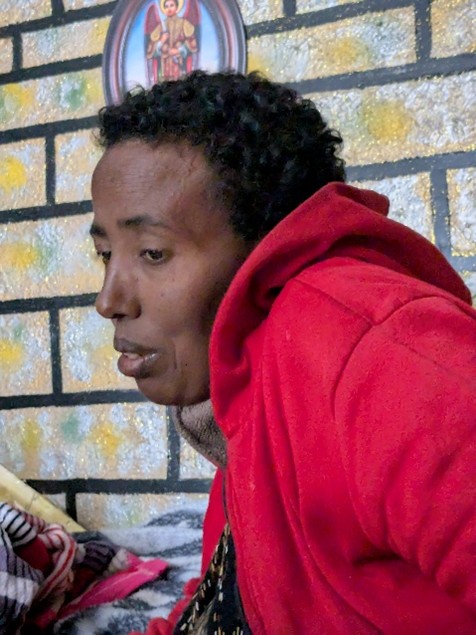
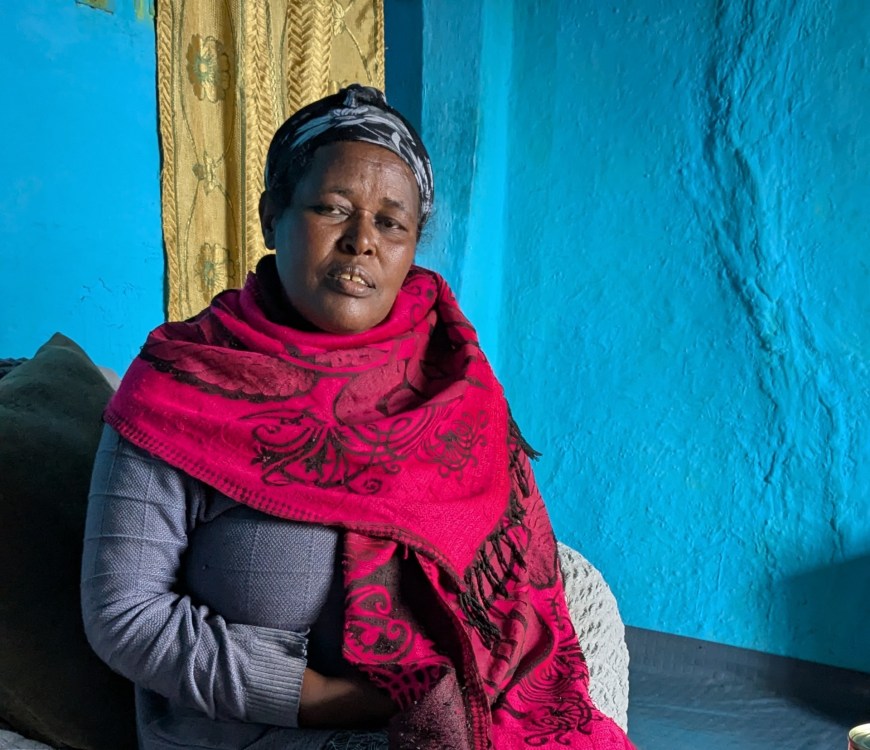
Genzeb* is a 45 year old woman with cervical cancer which was diagnosed 4 years ago. She received radiotherapy as surgery was not an option. Since receiving radiotherapy she has become incontinent and has radiation induced colitis (damage to the large intestine)**. 3 weeks prior to our visit she had received a 2 unit blood transfusion at the Black Lion Hospital, as the colitis had resulted in her being anaemic.

She was prescribed mesalazine suppositories to try and reduce the rectal bleeding. These are expensive, so her brothers and sisters pay for these as she is unable to afford them. She also has metronidazole vaginal douches to reduce the odour from her tumour. She receives a monthly grant from the Tewolde Medhane Comfort Fund, food support and sanitary products.

Genzeb is divorced and lives alone in a ‘condominium’. These are flats built by the government which are rented but can then be bought. Genzeb’s father had bought their flat but had died 10 months previously. There is now disagreement between Genzeb, who had lived with and cared for her father, and her 6 siblings about who owns the flat.

Genzeb follows the Christian Orthodox Tawahido religion and is part of a group of a spiritual and community support group with 12 members (Tsiwa). The group meets monthly to honour a saint, sharing a meal and engaging in prayer and singing. The small shrine in her house rotates to the other members of the group each month. Genzeb had set up the group because her brother had survived a serious accident.

When asked what difference Hospice Ethiopia had made to her life she replied “previously I couldn’t afford to get to my appointments at the hospital. I have nobody else who cares for me and wouldn’t be alive without Hospice Ethiopia’s support. Your service does a lot of important things, for example visiting people in their own homes. It is an example that other organisations should follow”.

*Not her real name

**It is reported that to increase the number of patients treated by radiotherapy and to reduce the waiting list at the Black Lion Hospital, the dose of radiotherapy per session was increased and the length of the course reduced. This has now been stopped due to the sharp increase in the side effects experienced by the patients.

The Big Give 2025

This year’s Big Give Christmas campaign is now live!

We are hoping to raise £10,200 to pay the salaries of 3 nurses at Hospice Ethiopia throughout 2026.

With your help we can reach our target. All donations large or small will be matched and will make a difference to supporting people who are approaching the end of life in Ethiopia. Many live in extreme poverty and without the care from Hospice Ethiopia’s nurses, may not have any help at all and suffer greatly.

If you are thinking of making a donation to support Hospice Ethiopia’s work, this is the week to do it. All donations made through the Big Give website will be doubled until noon on Tuesday 9th December.

One donation, twice the impact!

Please donate through Hospice Ethiopia UK’s Big Give page

Listen to Nurse Tsegay talk about working for Hospice Ethiopia. Last year’s Big Give appeal funded her and Rahel, a social worker to be trained in palliative care and work at Hospice Ethiopia:

Patient video: Kalkidan

Kalkidan, a patient of Hospice Ethiopia in Addis Ababa talks about her diagnosis and the difference that the care she has received from Hospice Ethiopia has made to her life.

Please note permission is sought prior to taking all photographs and videos. Names have been changed to protect privacy. Our thanks to Alan Miller for producing the video. 

Calendars, Christmas cards, and gift cards for sale now!

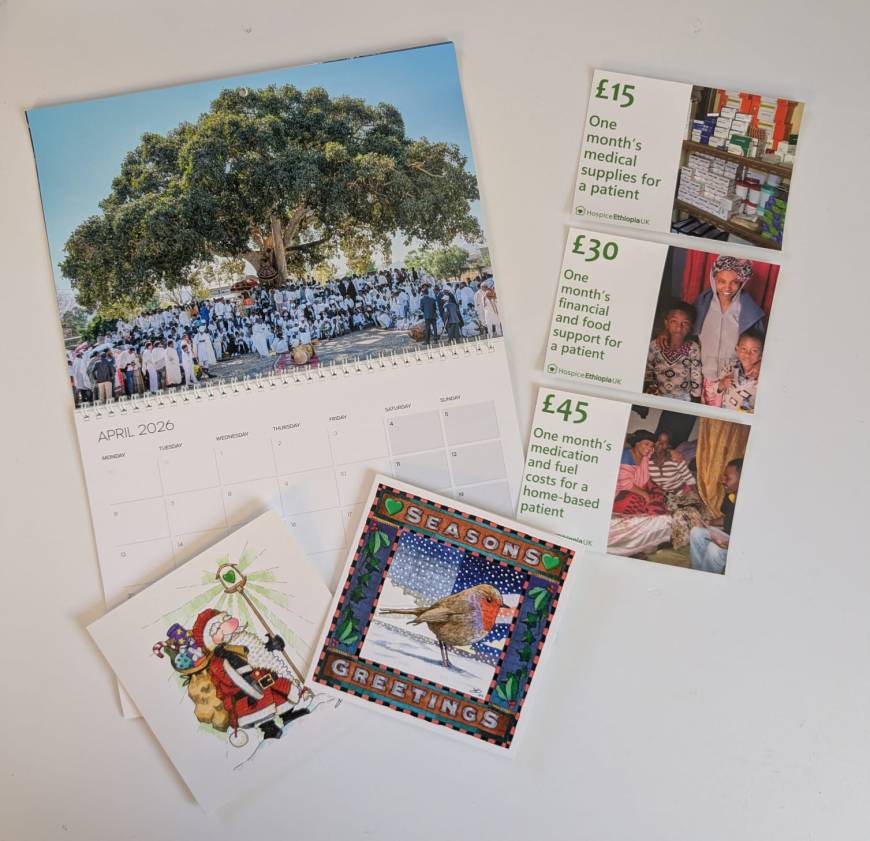
Get your orders in now – stock is limited! We are enormously grateful to professional journalists Fred Harter and Michele Spatari for providing the unique photographs of Ethiopia in our 2026 calendar – one each month. Calendars cost £10 + postage.

Christmas cards, with designs unique to Hospice Ethiopia UK, are £5 for a pack of 10 + postage (see the designs in the photo).

Gift cards are an alternative gift that helps support our work in Ethiopia. It might not be a present that you gift wrap, but it will bring joy both to the recipient and to vulnerable patients in Ethiopia. We have 3 different gifts at £15, £30, and £45 (see photo), so you’ll be able to find the right gift for your recipient to celebrate any occasion.

To purchase please email info@hospiceethiopia.org.uk 

Jill and Tim Morgan discuss their visit to Hospice Ethiopia

Jill: Even though I have been a trustee for 2 years and have had numerous conversations about the work of Hospice Ethiopia, the visit exceeded my expectations, and I realised how important face to face visits are to all those who work in the hospice. Tim and I were there to make videos of the work of the staff, not only the medical staff but also those who do the important back up, the guards, the drivers and the cook. What a joy to hear from everyone and being able to match the faces to the names I type in the minutes at trustee meetings.

The overriding feeling I experienced on driving into the compound was the warmth of the staff towards us and each other. The genuine feeling of pride in their compound and their work and desire to ‘show it off’. Having been shown around and introduced to the staff, Tim and I set about interviewing the staff to find out about working at Hospice Ethiopia. One of the most moving quotes from the interviews was from the guard Yeshitla in response to the question, ‘What do you like about working for Hospice Ethiopia?’

“I’ve worked here for twelve years, and I love the unique nature of the work of the hospice. I hope its work will spread throughout the whole of Ethiopia.”

Yeshitla

Gulilat Korbu (Finance and Administration Manager), in his interview, was anxious to thank HEUK for the funds from ‘The Big Give’, which meant he had the opportunity to visit Hospice Africa Uganda in Kampala and learn from the accounting team at that much bigger organisation.

Recent appointments funded by HEUK include Rahel Kebede and Tsehay Sahi as a social worker and nurse respectively. Rahel, who came from the court system is the first social worker appointed to work at Hospice Ethiopia. She has been included in some clinical palliative care training. Her role is to assess the social and financial needs of those patients and find practical solutions to deal with this aspect of living with terminal illness in a country with no welfare state.

The pressure on the team caused by increasing numbers of patients and developing awareness of the benefits of palliative care, will be alleviated by the appointment of Tsehay. With a background in nursing in schools this is a significant shift in focus for her career, but she talked about how interested she was in the new direction and her determination to upskill through lots of hard work.

The cook, Selamawit (Salamo) showed with pride her kitchen where she provides lunch for between 14-18 patients at the day care sessions every other Thursday. She also makes delicious coffee for the staff (and visitors) as well as cleaning the compound.

Selamawit

Kalkidan, an experienced nurse, talked movingly about her work visiting patients. She is about to study for a Diploma in Palliative Care, funded by HEUK at Nairobi Hospice. She is excited to learn new things. This is her first trip out of Ethiopia and in fact out of Addis Ababa.

Wengil Yared, the Programme Manager was a huge support to the interview process, she acted as interpreter and made useful suggestions as the interviews were filmed. ‘We love being part of the team,’ was mentioned by everyone.

Tim:  Patient visits in Addis aren’t a quick ten minute job – HE’s nurses will usually only be able to fit in four to six visits a day, with each one often lasting an hour.  They have a driver and typically it will take anything from 30 to 90 minutes to go from one patient to the next, driving along rutted paths, through the middle of busy markets, avoiding all sorts of obstacles – such as giant potholes or horses tethered in the middle of the road. Once you get to the address, you walk, perhaps along a narrow mud path, to a single-room earth and straw shack with a tin roof and no windows.  Despite the unimaginable poverty, people are welcoming.  In one visit, I was sent out of the home while the patent was examined and a neighbour, seeing me taking photos, came out with a stool for me to sit on while I waited.   (She didn’t speak but smiled at my excruciating attempt at ‘ameuseugenallo’ (thank you)).  The patients themselves were usually willing to share their story on video.  All the ones we saw were women, almost always they had been abandoned by their husbands, who tended to blame the patient for the illness.  Hopefully a relative or neighbour would be on hand to offer support, but certainly not always.  They spoke of their illness and how Hospice Ethiopia had changed their lives, not only in terms of alleviating their symptoms but also with financial and spiritual help.  And as we went, they blessed us.  Which made us feel humbled but also ashamed, guilty at the luck of the draw that gave us so much. 

Jill and Tim: We marvelled at the contrasts in Addis, the huge building projects being undertaken to create a ‘Dubai of Africa’, and the pride of the Ethiopians in this extraordinary remodelling, whilst many are living in extreme poverty in dwellings on the streets. The traffic, and fumes, which made travelling around the city very time consuming, seemed to be an accepted part of the day. I had to close my eyes on many an occasion but there was no evident road rage or frustration, just acceptance, something it was hard for us to comprehend.

Everywhere we were greeted with warmth and hospitality and care. Patience and love, that’s my takeaway from Ethiopia.

African Palliative Care Association Conference

Sue and Jamie Mumford attended the 8th International African Palliative Care Association conference in Gaborone, Botswana in September. Two colleagues from Hospice Ethiopia, Executive Director Ephrem Abathun and Programme Manager Wengel Yared joined them there. Dr Nuhamin Tekle from Ethiopia attended as did Professor Nicola Ayers (who has worked as a voluntary advisor to the Ethiopian government over the past few years).

Speakers at this 3 day conference came from across Africa and beyond; presentations described the delivery of palliative care services in a wide range of settings, often in very challenging environments for example Dr Germanus Nathuhwera described setting up a roadside outreach programme in Northern Uganda to provide palliative care to the estimated 1.9 million refugees living in camps there.

Prof Julia Downing from UK delivered a presentation on behalf of the ICPCN (International Children’s Palliative Care Network) about palliative care for children in Africa. 52% (11million) of children in the world who need palliative care are in Africa. Many suffer as they have no access to palliative care. Despite recommendations made in 2010 advocating for palliative care services for children to be established, progress has been slow. In Ethiopia, there is no such service at present. However, Hospice Ethiopia is working towards rectifying this: 2 nurses and a doctor are undertaking online training, and a new children’s palliative care service will be established in 2026.

Sue was privileged to be able to give a presentation on the audit of symptoms experienced by the patients registered with Hospice Ethiopia in Addis Ababa. Our colleagues from Hospice Ethiopia gave an important poster presentation about their programme to train religious leaders in Ethiopia in the ethos of palliative care; this is still a little-known discipline in Ethiopia.

As well as hearing the thought-provoking and inspiring presentations, the conference provided the opportunity to reconnect with old friends and meet new colleagues working in palliative care from across Africa. It was good to see Dr Nuhamin Tekle, family physician and palliative care adviser to the Ethiopian Ministry of Health who gave a presentation about her PhD project to develop a mobile phone app to improve access to palliative care for people across Ethiopia. The app empowers community health workers to make decisions about how to manage their patients’ symptoms. She was shortlisted for an APCA Africa-wide innovation award and received 3rd prize.

The conference was filled with energy and passion throughout the sessions. Key messages from it were the importance of collaboration and learning from others. One of the essential factors in developing palliative care services is the involvement and commitment from governments to develop policies and provide budgets to enable palliative care to be integrated into universal health coverage. Another key message is that new and developing digital technologies will aid patient access to palliative care. High-tech technologies will improve the low-tech discipline of palliative care. The procurement, supply, and access of essential medicines in palliative care remains a huge issue across the African continent.

Photo from the conference; left to right: Nicola Ayers, Nuhamin Tekle, Wengil Yared, Ephrem Abathun, Jamie Mumford, Sue Mumford.

Please support Matt and Ian!

On Sunday, 14 September 2025, Matt and Ian (Sue and Jamie Mumford’s sons-in-law) will take on the iconic London to Brighton Cycle Ride – a 55-mile journey from city streets to seaside views, with more than 3,200 ft of climbing. But this ride is more than a personal challenge – it’s a mission to raise vital funds for Hospice Ethiopia UK.

Matt and Ian have poured their hearts (and legs!) into training, and now they need your support. Every donation – big or small – helps make their ride truly meaningful. Please sponsor the ride and support Hospice Ethiopia UK here.

Patient story – Afework

Afework is a 60 year old Christian Orthodox man with throat cancer. It was diagnosed a year ago when he noticed discharge from his nose. Following diagnosis, he received 34 treatments of radiotherapy and 8 cycles of chemotherapy. Initially, post-treatment, he had severe radiotherapy burns to his neck (we were shown a photo) and the skin was very damaged. This has now healed but he continues to have a very dry mouth and therefore difficulty swallowing. He had lost weight over the last year due to this.

Afework lives with his wife and has 4 grown up children. He worked as a driver for 32 years and is hoping to return to work, as there was no sign that the cancer had spread on a recent CT scan.

He was not taking any regular medication although we suggested he try chewing gum to stimulate his own saliva (artificial saliva is not available in Ethiopia). Kalkidan checked his mouth and there was no sign of candida (thrush) infection. She discussed his diet with him, particularly bearing in mind he looked (and has been told) that he is anaemic. He receives food support from Hospice Ethiopia in the form of rice, oats and teff which his wife can make into a “porridge”. A doctor had advised him to get Plumpnet (a high calorie drink) from the local Health Centre. However, when he went to the Health Centre he was told it is only available for mal-nourished children.

The nurses from Hospice Ethiopia will continue to offer him and his wife advice and support.

Pride and Prejudice dramatised reading raises over £2,400 for Hospice Ethiopia

Mr Darcy helped a Norfolk-based charity raise nearly £2,500 for desperate patients in Ethiopia.  Templewood, the privately-owned Palladian-style shooting lodge near Cromer, was the venue for a dramatic reading of Pride and Prejudice on July 27th 2025.  The cast was a combination of professional actors and amateurs, and the audience was treated to live classical music and a cream tea as well as the drama. 

Sue Mumford is chair of Hospice Ethiopia UK, the charity based in Aldborough, North Norfolk.  She said, “What a fabulous venue Templewood is!  We are so grateful to the owners, Eddie and Tina Anderson, for letting us use their beautiful home.” 

This was the third annual Jane Austen event by Hospice Ethiopia, the previous ones being held at Little Barningham Hall and Cromer Hall, and it was another sell-out.  Next year the team hopes to take on Sense and Sensibility – with the venue yet to be decided.    

“The readings are a snapshot from a section of the books,” Sue says.  “Our script writer, Margy Seale, delights in using the original language to create a truly authentic piece of theatre.  They really are great fun – and it’s a brilliant cause.”