
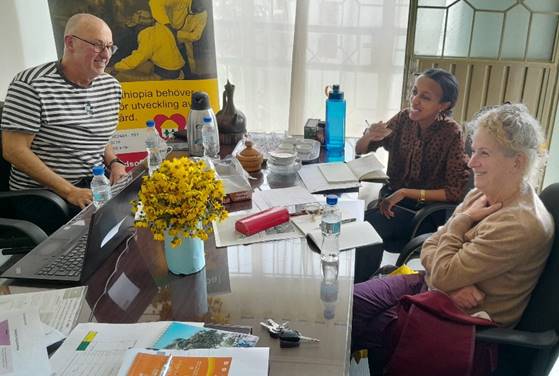
Jill: Even though I have been a trustee for 2 years and have had numerous conversations about the work of Hospice Ethiopia, the visit exceeded my expectations, and I realised how important face to face visits are to all those who work in the hospice. Tim and I were there to make videos of the work of the staff, not only the medical staff but also those who do the important back up, the guards, the drivers and the cook. What a joy to hear from everyone and being able to match the faces to the names I type in the minutes at trustee meetings.
The overriding feeling I experienced on driving into the compound was the warmth of the staff towards us and each other. The genuine feeling of pride in their compound and their work and desire to ‘show it off’. Having been shown around and introduced to the staff, Tim and I set about interviewing the staff to find out about working at Hospice Ethiopia. One of the most moving quotes from the interviews was from the guard Yeshitla in response to the question, ‘What do you like about working for Hospice Ethiopia?’
“I’ve worked here for twelve years, and I love the unique nature of the work of the hospice. I hope its work will spread throughout the whole of Ethiopia.”
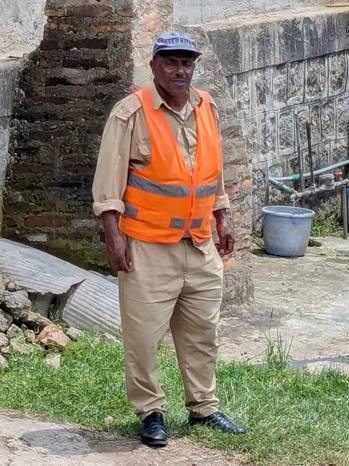
Yeshitla
Gulilat Korbu (Finance and Administration Manager), in his interview, was anxious to thank HEUK for the funds from ‘The Big Give’, which meant he had the opportunity to visit Hospice Africa Uganda in Kampala and learn from the accounting team at that much bigger organisation.
Recent appointments funded by HEUK include Rahel Kebede and Tsehay Sahi as a social worker and nurse respectively. Rahel, who came from the court system is the first social worker appointed to work at Hospice Ethiopia. She has been included in some clinical palliative care training. Her role is to assess the social and financial needs of those patients and find practical solutions to deal with this aspect of living with terminal illness in a country with no welfare state.
The pressure on the team caused by increasing numbers of patients and developing awareness of the benefits of palliative care, will be alleviated by the appointment of Tsehay. With a background in nursing in schools this is a significant shift in focus for her career, but she talked about how interested she was in the new direction and her determination to upskill through lots of hard work.
The cook, Selamawit (Salamo) showed with pride her kitchen where she provides lunch for between 14-18 patients at the day care sessions every other Thursday. She also makes delicious coffee for the staff (and visitors) as well as cleaning the compound.
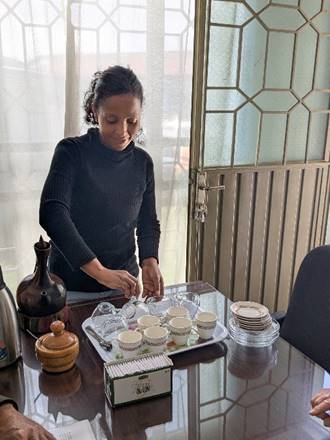
Selamawit
Kalkidan, an experienced nurse, talked movingly about her work visiting patients. She is about to study for a Diploma in Palliative Care, funded by HEUK at Nairobi Hospice. She is excited to learn new things. This is her first trip out of Ethiopia and in fact out of Addis Ababa.
Wengil Yared, the Programme Manager was a huge support to the interview process, she acted as interpreter and made useful suggestions as the interviews were filmed. ‘We love being part of the team,’ was mentioned by everyone.
Tim: Patient visits in Addis aren’t a quick ten minute job – HE’s nurses will usually only be able to fit in four to six visits a day, with each one often lasting an hour. They have a driver and typically it will take anything from 30 to 90 minutes to go from one patient to the next, driving along rutted paths, through the middle of busy markets, avoiding all sorts of obstacles – such as giant potholes or horses tethered in the middle of the road. Once you get to the address, you walk, perhaps along a narrow mud path, to a single-room earth and straw shack with a tin roof and no windows. Despite the unimaginable poverty, people are welcoming. In one visit, I was sent out of the home while the patent was examined and a neighbour, seeing me taking photos, came out with a stool for me to sit on while I waited. (She didn’t speak but smiled at my excruciating attempt at ‘ameuseugenallo’ (thank you)). The patients themselves were usually willing to share their story on video. All the ones we saw were women, almost always they had been abandoned by their husbands, who tended to blame the patient for the illness. Hopefully a relative or neighbour would be on hand to offer support, but certainly not always. They spoke of their illness and how Hospice Ethiopia had changed their lives, not only in terms of alleviating their symptoms but also with financial and spiritual help. And as we went, they blessed us. Which made us feel humbled but also ashamed, guilty at the luck of the draw that gave us so much.
Jill and Tim: We marvelled at the contrasts in Addis, the huge building projects being undertaken to create a ‘Dubai of Africa’, and the pride of the Ethiopians in this extraordinary remodelling, whilst many are living in extreme poverty in dwellings on the streets. The traffic, and fumes, which made travelling around the city very time consuming, seemed to be an accepted part of the day. I had to close my eyes on many an occasion but there was no evident road rage or frustration, just acceptance, something it was hard for us to comprehend.
Everywhere we were greeted with warmth and hospitality and care. Patience and love, that’s my takeaway from Ethiopia.

 Hospice Ethiopia UK