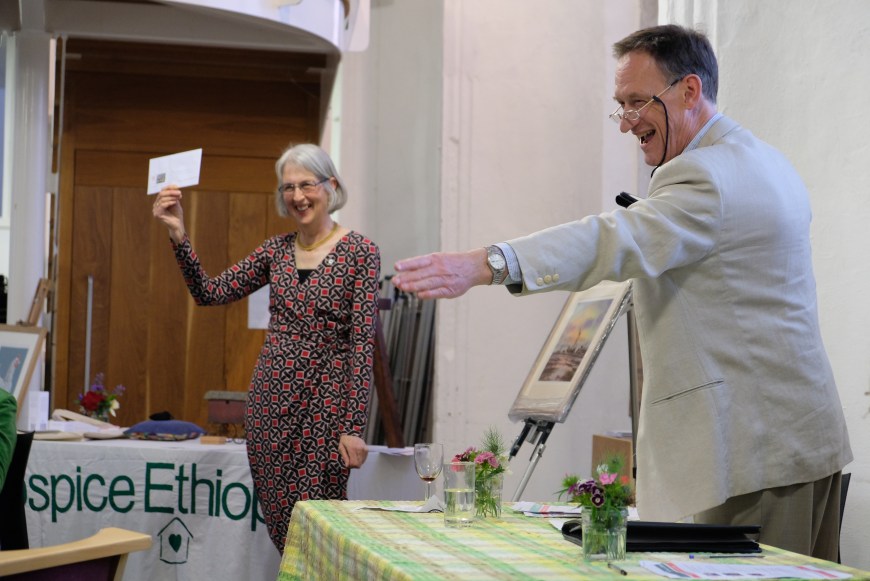
Hospice Ethiopia’s wine and cheese and auction of promises was a fantastic evening and raised over £2,700. Every penny of this will go to support Hospice Ethiopia. A massive thank you to the hugely entertaining Mrs Temple, for both her wonderful cheeses and her insightful presentation. Also thanks to the equally entertaining master of ceremonies and auctioneer extraordinaire David Robinson. Yet more thanks to all who donated lots for the auction and prizes for the raffle. Lastly, our thanks goes to our wonderful volunteers who worked so hard to make it all happen and all those who dug deep and bought the lots!
June 2024 news from Ethiopia
Hospice Ethiopia UK’s Chair Sue Mumford has monthly online calls with Director of Hospice Ethiopia UK, Ephrem Abathun. Here is some of the latest news from Ethiopia:
- Ephrem has been in discussions with the Ethiopian Ministry of Health about revising and publishing a new strategic plan for Palliative Care in Ethiopia. Crucially the provision of morphine is included for the first time in the revised plan.
- The Minister of Health has now issued the necessary documents for the Black Lion Hospital to import morphine powder to produce oral morphine liquid. The American Cancer Society has purchased the morphine powder so we are optimistic that oral morphine solution will soon be available to relieve the pain for the dying in Ethiopia. Initially this medicine will be available for patients at Black Lion Hospital before being expanded to other hospitals in Addis Adaba and then to regional hospitals across the country.

- Training: Ephrem and his staff laid on a workshop for Chaplains and representatives from the Christian Orthodox, Protestant and Muslim communities. Following this a draft training manual is being produced for training religious leaders in supporting terminally ill patients. As part of this work some of Hospice Ethiopia’s patients were questioned about what spiritual care they felt is needed when approaching the end of life. All this will help deliver the individualised care that people approaching the end of life deserve.
- Following a joint application between Hospice Ethiopia and Hospice Ethiopia UK, True Colours Trust (a UK charity that supports palliative care providers across Africa) is providing funding for a 4 day palliative care training course at Hiwot Fana Hospital in Harar later this month. Harar is a holy Islamic city in eastern Ethiopia and is known for its maze-like alleys and traditional houses decorated inside with flat baskets.
- Hospice Ethiopia UK and Hospice Ethiopia has recently been approached by Dr Yates from Soddo Christian Hospital (situated in the Oromia part of Southern Ethiopia) to provide palliative care training for their staff. The hospital serves a population of over 20 million people. Planning is in the early stages for this training to be delivered in the autumn when some of HEUK’s trustees will be visiting Ethiopia.
Doctor receives palliative care training funded by HE UK
Money raised by Hospice Ethiopia UK has been used to fund training for a doctor based in Southern Ethiopia, Dr Juhliad. His interest in palliative care started in 2019 when he received a three day introduction to palliative care at The Black Lion Hospital in Addis Ababa, delivered by Hospice Ethiopia’s Director, Ephrem. Dr Juhliad now works at Yabelo Hospital which is a town in the Oromia region, 580km south of Addis Ababa. Here he sees patients who desperately need symptom management and end-of-life care. With our help this year he has completed the foundation course in palliative medicine at Trivandrum Institute of Palliative Sciences and is now attending a Master Class course that will go on until December 2024. He will go to India for ‘hands-on’ clinical training in November 2024 as part of the course. This is what he told us:
“The hospital where I am based now doesn’t have a specific place dedicated to patients needing palliative care. And it seems difficult to persuade the hospital administrators to integrate palliative care services for now. But I am trying to integrate palliative care practice into my daily routine for patients who might be candidates for such services at a chronic disease medical outpatient department. Moreover, I am intending to launch a free telehealth service for patients needing palliative care through my social media platforms…I am also interested in providing webinars on palliative care for frontline healthcare workers.”
A day in the life of Ephrem Abathun
When the trustees visited Hospice Ethiopia last month, we took the opportunity to ask Hospice Ethiopia’s Director, Ephrem Abathun what a typical working day looked like for him. We thought you might be interested to hear what he said.
His day usually starts about 6am but may be earlier if he has international guests visiting. He aims to leave home around 6.30am after eating some kinche (cracked wheat) or eggs with bread and has an hour’s drive (25km) to the HE premises. Ethiopian coffee (and occasionally tea) is drunk with breakfast, in the morning, after lunch and mid-afternoon. Gullilat Korbu (Finance Officer), Wengi Yared (Programme Manager), and the nurses arrive shortly after him, between 7.30-8am.
Ephrem’s working day begins with reviewing operational activities so that he knows what he has to prioritise and on certain days of the week there are regular weekly meetings for example on Monday mornings he has meetings with the staff and the management team (Wengi Yared and Gullilat Korbu). Lunch is around midday and is always a working lunch. He either brings lunch from home – “spaghetti pasta” or he meets international guests for a working lunch. On Monday afternoons he holds a clinical meeting with the nurses when difficult and distressing cases are discussed. He tries hard to make sure this meeting is not cancelled as it is a good opportunity to share his experience and build good working relationships with his clinical staff.
There a number of things that have to be fitted in around meetings and appointments for example, working on project applications with Wengi, speaking to local partners on the phone for example the Addis Adaba Health Bureau, attending face to face and virtual meetings with donors and partners, and writing reports.
During the last 2 years he has rarely had time to visit patients himself who are registered on the Home Based Care programme but now that doctorate is finished he hopes to have more time to support the nurses carrying out these visits. Certainly Hospice Ethiopia’s patients benefit hugely from his wealth of experience.
Ephrem usually leaves the office around 6-7pm and then has an hour’s drive home, receiving phone calls from staff, partners and others on his way. He tries to eat supper with his wife and 2 girls (aged 9 and 12) when he arrives home, which might be pasta, injera, barley bread and vegetables. Meat (beef) is eaten once or twice a week. (Beef is the cheapest meat in Ethiopia and is cheaper than goat, chicken, lamb and is produced across Ethiopia.) Once his daughters are in bed there is often more work to catch up with.
Ephrem works 5 days a week in theory but at weekends he works at least a further ½ day’s work. He tries hard not to work at all on Sundays so that he can spend time with his family.
This typical day looks pretty straight forward but from our experience working in Ethiopia is challenging. Long traffic jams, intermittent internet, massive paperwork demands by regulatory authorities, lack of internet banking and certainly no internet shopping all demand the patience of a saint. Fortunately Hospice Ethiopia’s Executive Director is one of these!
TRUSTEE REPORT ON VISIT TO ETHIOPIA FEB 24
Please see the full report for Sue, Jamie and Rebecca’s trustee visit to Hospice Ethiopia in February here.
Ephrem features in The Guardian
The Guardian newspaper has recognised what we have known for many years, that the Director of Hospice Ethiopia, Ephrem Abathun, is one of the truly inspirational people alive in the world today! He richly deserves this recognition for his amazing dedication to his work. Read all about him and his work here.
British doctor volunteering at Hospice Ethiopia
A British doctor, Fredrika Collins, is currently living in Ethiopia and volunteering at the Hospice in her free time. She’s written an article for us about her time there:
I am Fredrika, a doctor from the UK, working in Addis Ababa, Ethiopia, hoping to specialise in Palliative Care.
I have been living in Addis Ababa for 7 months. I arrived just before the Meskel celebration in September 2022, an important date in the Christian Orthodox calendar which commemorates the finding of the True Cross. This impressive spectacle sees thousands of worshippers congregate in Meskel Square, Addis Ababa’s main square, dressed in traditional white robes and holding lit candles, as they sing together in front of a gigantic bonfire. It was an early introduction into Ethiopian culture, where the main religion is Orthodox Christianity. Tradition and faith run strongly through communities.
I’m working as an internist at a busy international hospital among a majority Ethiopian team. I have found the work challenging but incredibly stimulating. During my days off I’ve had the great privilege of volunteering with Hospice Ethiopia, where the vast inequality between their patients and those at the private hospital where I work has become apparent.
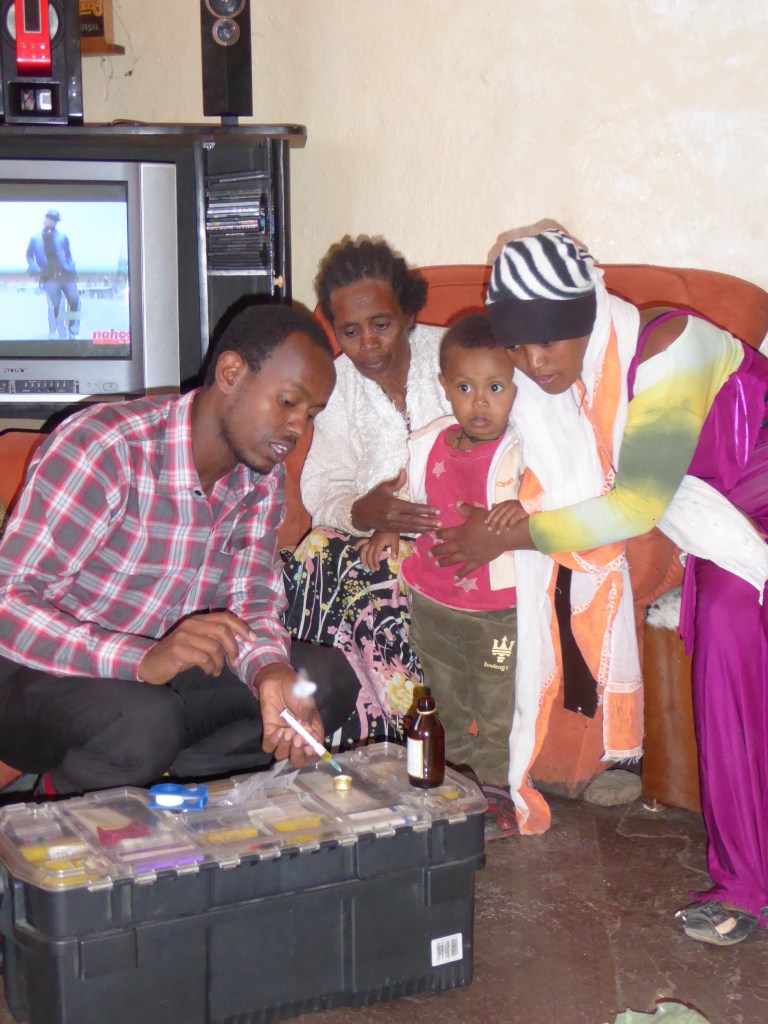
During my time with Hospice Ethiopia I have joined Nurse Filagot on several of her home visits and I have been blown away by her skill, dedication and compassion. The main issues I saw confronting patients were poverty, social isolation and uncontrolled pain, the latter largely arising from a chronic shortage of oral morphine in Ethiopia. Unwell patients who can no longer work often can’t afford basic necessities, let alone hospital care or expensive medical supplies such as stoma bags. Sometimes they become cut off from their community or family which is particularly sad to see.
It has been inspiring to watch Nurse Filagot navigate these many problems with only limited resources. Depending on the patients’ needs she provided medicines, economic or food support packages, referrals to health facilities and always a listening ear. She often acted as an intermediary between the patient and their family to help resolve conflict or misunderstanding.
Patients who are socially isolated and able to travel to the main Hospice Ethiopia site have the opportunity to join the weekly day centre, where they can enjoy coffee, lunch, music, talking and of course – never an opportunity to be missed – traditional Ethiopian dancing, known as eskista. Joining this session, led by Wengi, the brilliant project director, was extremely heart warming and I could see how happy and animated the group became.
Last month I also had the chance to travel to Kampala, Uganda, to visit the main Hospice Africa site and meet the legendary Dr Anne Merriman. An article about the team’s work recently appeared here in The Guardian. I toured their morphine production unit, a series of stainless steel containers in a small room that supplies all of Uganda’s oral morphine. Before this production unit came into action, Uganda’s population faced the same restricted supply of oral morphine as Ethiopia does today. The hope is that a similar system can be set up in Addis Ababa, which would be truly transformational for the many terminally ill patients living in extreme uncontrolled pain throughout Ethiopia.
I am grateful to Hospice Ethiopia for welcoming me into their team and look forward to the next year working with them.
Abena’s Story
Abena (not her real name) is a 38-year-old married lady with breast cancer. On her first visit Nurse Filagot from Hospice Ethiopia carried out a full assessment of her needs. She had been seen by her local health centre several months ago when the diagnosis had been made but had declined further investigations and treatment. She returned to the health centre when the cancer spread to become an open wound, and was referred to the regional hospital and then on to St Paul’s hospital in Addis Adaba for treatment. This meant she had to travel by bus for over 24 hours to the capital, leaving behind her husband and 3 children, aged 15 (with autism), 10 and 6. She was able to stay with her sister but this involved sleeping on the floor of the sitting room.
The assessment was difficult as she only spoke a regional language (there are over 80 in Ethiopia) and was illiterate, but with her sister’s help Nurse Filagot was able to establish her symptoms. She had suffered for at least 50 days with extensive ‘burning’ pain across her body; the cause of which was unknown. She had local spread of her cancer creating an open wound across her breast. She had received one cycle of chemotherapy at St Paul’s Hospital, leaving her feeling exhausted and nauseous. She was also suffering from a low mood which was evident by her lack of eye contact and general demeanour.
Nurse Filagot established a plan for her care. She gave her a course of amitriptyline 12.5mg daily for her pain and metoclopramide for her nausea. She provided dressings and topical metronidazole for the breast wound. She then explained the risks of neutropenic sepsis (which can be caused by chemotherapy) and spent time listening to her concerns and anxieties. She plans to visit again in a week to monitor her symptoms.
Welcome to Dr Fredrika Collins
Hospice Ethiopia is delighted to be welcoming Dr Fredrika Collins to work as a volunteer for the next few months. Before she leaves the England’s shores, she is raising money for the Hospice by swimming between the 2 piers at Brighton – a distance of about 1km. Please support this valiant effort by donating via JustGiving.

Fredrika is an internal medicine trainee in Brighton, exploring a career in palliative care. In September 2022 she is moving to Addis Ababa, Ethiopia, to work for a year as a teaching fellow within the internal medicine department of Addis Ababa University. During this time she will also be volunteering for Hospice Ethiopia, by working clinically in their Day Care, Outpatients, and Home care programmes and assisting with education and training.
She completed her undergraduate medical degree at King’s College London, and foundation training at Croydon University Hospital. Between 2019-2020 she worked as a research assistant in Peru on a trial investigating the health benefits of clean cooking gas, before moving to Brighton to commence her internal medicine training.
She is particularly interested in the role of healthcare professionals in tackling local health inequalities, and set up the Health Education England approved ‘The Global Health Series’ in 2018, which continues to run at several trusts across London and the Southeast.
Quartely reports from hospice Ethiopia
The trustees of Hospice Ethiopia UK receive quarterly reports from the staff of Hospice Ethiopia. They report on a range of activities undertaken by the Hospice which helps us monitor the way the funds we send them are spent as well as helping us to understand the challenges they face.
The recent report records that they are supporting 85 patients through their home-base care programme. This is slightly fewer than in the previous quarter as fewer referrals have been received. The Director thinks this is probably due to fewer patients presenting at hospital as they are worried about leaving their homes due to the coronavirus pandemic.
The Day Care service run at the Hospice has had to be temporarily suspended due to the restrictions imposed by the government due to the pandemic. However, 25 patients are supported by the Comfort Fund; this is a monthly grant given to the poorest patients to enable them to buy food and other essential supplies. Our Coin jars support this fund; if you would like to have one, please contact Sue (01263 768699) or set up your own jar for collecting lose change for this vital fund.
The staff of Hospice Ethiopia in collaboration with the Federal Ministry of Health have provided training for a range of health care workers, on palliative care for people dying from corona virus. This included support for front line workers in supporting both patients and their families with their distress, medical needs and end of life care.
Earlier this year Hospice Ethiopia expanded its services by establishing a partnership with the Tibebe Ghion Hospital in Bahir Dar. This has proved to be a cost-effective model and plans are underway to replicate this at Hawassa and other major cities in Ethiopia.