Calendars, Christmas cards, and gift cards for sale now!

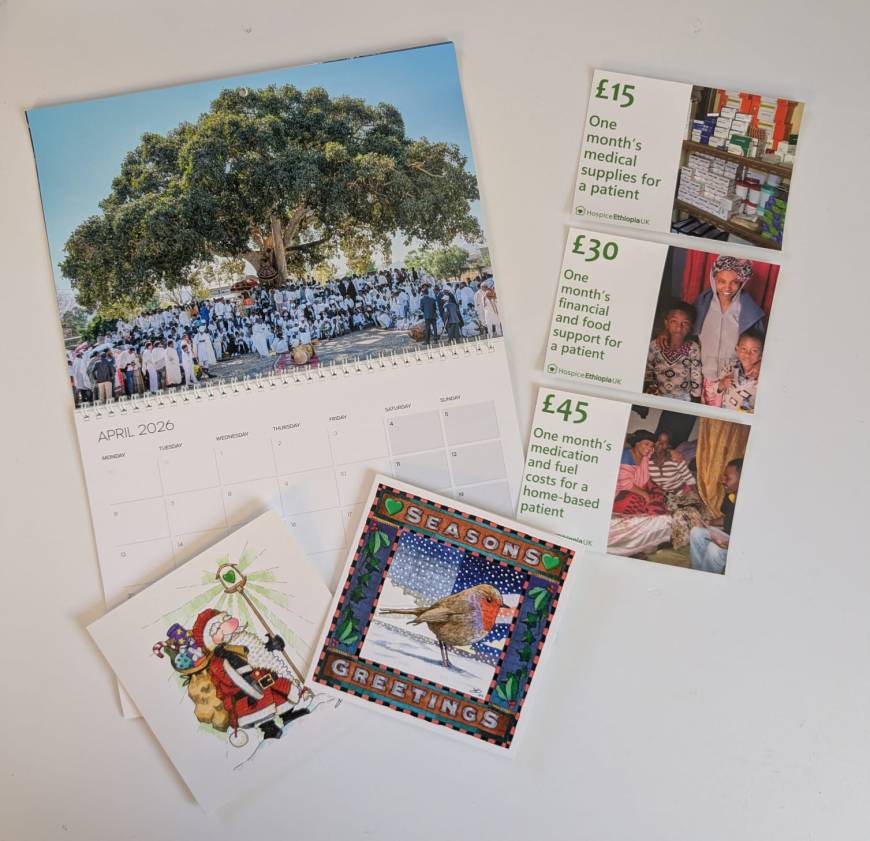
Get your orders in now – stock is limited! We are enormously grateful to professional journalists Fred Harter and Michele Spatari for providing the unique photographs of Ethiopia in our 2026 calendar – one each month. Calendars cost £10 + postage.

Christmas cards, with designs unique to Hospice Ethiopia UK, are £5 for a pack of 10 + postage (see the designs in the photo).

Gift cards are an alternative gift that helps support our work in Ethiopia. It might not be a present that you gift wrap, but it will bring joy both to the recipient and to vulnerable patients in Ethiopia. We have 3 different gifts at £15, £30, and £45 (see photo), so you’ll be able to find the right gift for your recipient to celebrate any occasion.

To purchase please email info@hospiceethiopia.org.uk 
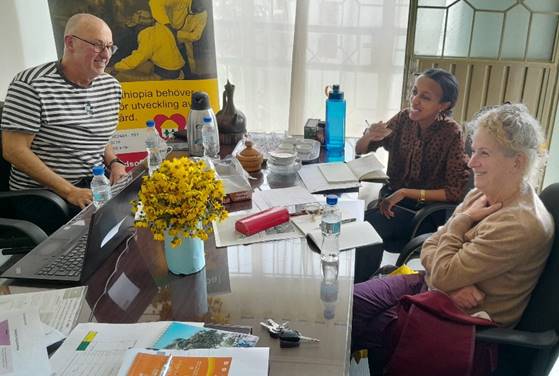
Jill and Tim Morgan discuss their visit to Hospice Ethiopia

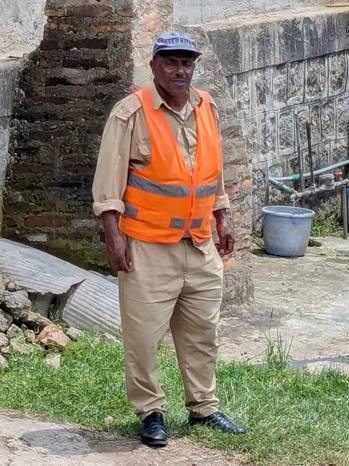
Jill: Even though I have been a trustee for 2 years and have had numerous conversations about the work of Hospice Ethiopia, the visit exceeded my expectations, and I realised how important face to face visits are to all those who work in the hospice. Tim and I were there to make videos of the work of the staff, not only the medical staff but also those who do the important back up, the guards, the drivers and the cook. What a joy to hear from everyone and being able to match the faces to the names I type in the minutes at trustee meetings.

The overriding feeling I experienced on driving into the compound was the warmth of the staff towards us and each other. The genuine feeling of pride in their compound and their work and desire to ‘show it off’. Having been shown around and introduced to the staff, Tim and I set about interviewing the staff to find out about working at Hospice Ethiopia. One of the most moving quotes from the interviews was from the guard Yeshitla in response to the question, ‘What do you like about working for Hospice Ethiopia?’

“I’ve worked here for twelve years, and I love the unique nature of the work of the hospice. I hope its work will spread throughout the whole of Ethiopia.”

Yeshitla

Gulilat Korbu (Finance and Administration Manager), in his interview, was anxious to thank HEUK for the funds from ‘The Big Give’, which meant he had the opportunity to visit Hospice Africa Uganda in Kampala and learn from the accounting team at that much bigger organisation.

Recent appointments funded by HEUK include Rahel Kebede and Tsehay Sahi as a social worker and nurse respectively. Rahel, who came from the court system is the first social worker appointed to work at Hospice Ethiopia. She has been included in some clinical palliative care training. Her role is to assess the social and financial needs of those patients and find practical solutions to deal with this aspect of living with terminal illness in a country with no welfare state.

The pressure on the team caused by increasing numbers of patients and developing awareness of the benefits of palliative care, will be alleviated by the appointment of Tsehay. With a background in nursing in schools this is a significant shift in focus for her career, but she talked about how interested she was in the new direction and her determination to upskill through lots of hard work.

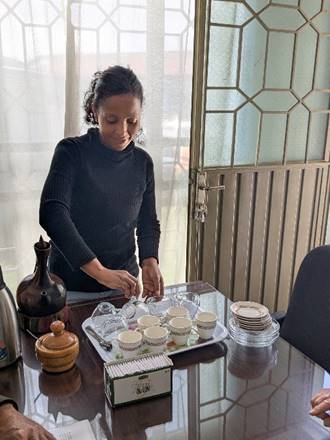
The cook, Selamawit (Salamo) showed with pride her kitchen where she provides lunch for between 14-18 patients at the day care sessions every other Thursday. She also makes delicious coffee for the staff (and visitors) as well as cleaning the compound.

Selamawit

Kalkidan, an experienced nurse, talked movingly about her work visiting patients. She is about to study for a Diploma in Palliative Care, funded by HEUK at Nairobi Hospice. She is excited to learn new things. This is her first trip out of Ethiopia and in fact out of Addis Ababa.

Wengil Yared, the Programme Manager was a huge support to the interview process, she acted as interpreter and made useful suggestions as the interviews were filmed. ‘We love being part of the team,’ was mentioned by everyone.

Tim:  Patient visits in Addis aren’t a quick ten minute job – HE’s nurses will usually only be able to fit in four to six visits a day, with each one often lasting an hour.  They have a driver and typically it will take anything from 30 to 90 minutes to go from one patient to the next, driving along rutted paths, through the middle of busy markets, avoiding all sorts of obstacles – such as giant potholes or horses tethered in the middle of the road. Once you get to the address, you walk, perhaps along a narrow mud path, to a single-room earth and straw shack with a tin roof and no windows.  Despite the unimaginable poverty, people are welcoming.  In one visit, I was sent out of the home while the patent was examined and a neighbour, seeing me taking photos, came out with a stool for me to sit on while I waited.   (She didn’t speak but smiled at my excruciating attempt at ‘ameuseugenallo’ (thank you)).  The patients themselves were usually willing to share their story on video.  All the ones we saw were women, almost always they had been abandoned by their husbands, who tended to blame the patient for the illness.  Hopefully a relative or neighbour would be on hand to offer support, but certainly not always.  They spoke of their illness and how Hospice Ethiopia had changed their lives, not only in terms of alleviating their symptoms but also with financial and spiritual help.  And as we went, they blessed us.  Which made us feel humbled but also ashamed, guilty at the luck of the draw that gave us so much. 

Jill and Tim: We marvelled at the contrasts in Addis, the huge building projects being undertaken to create a ‘Dubai of Africa’, and the pride of the Ethiopians in this extraordinary remodelling, whilst many are living in extreme poverty in dwellings on the streets. The traffic, and fumes, which made travelling around the city very time consuming, seemed to be an accepted part of the day. I had to close my eyes on many an occasion but there was no evident road rage or frustration, just acceptance, something it was hard for us to comprehend.

Everywhere we were greeted with warmth and hospitality and care. Patience and love, that’s my takeaway from Ethiopia.

African Palliative Care Association Conference

Sue and Jamie Mumford attended the 8th International African Palliative Care Association conference in Gaborone, Botswana in September. Two colleagues from Hospice Ethiopia, Executive Director Ephrem Abathun and Programme Manager Wengel Yared joined them there. Dr Nuhamin Tekle from Ethiopia attended as did Professor Nicola Ayers (who has worked as a voluntary advisor to the Ethiopian government over the past few years).

Speakers at this 3 day conference came from across Africa and beyond; presentations described the delivery of palliative care services in a wide range of settings, often in very challenging environments for example Dr Germanus Nathuhwera described setting up a roadside outreach programme in Northern Uganda to provide palliative care to the estimated 1.9 million refugees living in camps there.

Prof Julia Downing from UK delivered a presentation on behalf of the ICPCN (International Children’s Palliative Care Network) about palliative care for children in Africa. 52% (11million) of children in the world who need palliative care are in Africa. Many suffer as they have no access to palliative care. Despite recommendations made in 2010 advocating for palliative care services for children to be established, progress has been slow. In Ethiopia, there is no such service at present. However, Hospice Ethiopia is working towards rectifying this: 2 nurses and a doctor are undertaking online training, and a new children’s palliative care service will be established in 2026.

Sue was privileged to be able to give a presentation on the audit of symptoms experienced by the patients registered with Hospice Ethiopia in Addis Ababa. Our colleagues from Hospice Ethiopia gave an important poster presentation about their programme to train religious leaders in Ethiopia in the ethos of palliative care; this is still a little-known discipline in Ethiopia.

As well as hearing the thought-provoking and inspiring presentations, the conference provided the opportunity to reconnect with old friends and meet new colleagues working in palliative care from across Africa. It was good to see Dr Nuhamin Tekle, family physician and palliative care adviser to the Ethiopian Ministry of Health who gave a presentation about her PhD project to develop a mobile phone app to improve access to palliative care for people across Ethiopia. The app empowers community health workers to make decisions about how to manage their patients’ symptoms. She was shortlisted for an APCA Africa-wide innovation award and received 3rd prize.

The conference was filled with energy and passion throughout the sessions. Key messages from it were the importance of collaboration and learning from others. One of the essential factors in developing palliative care services is the involvement and commitment from governments to develop policies and provide budgets to enable palliative care to be integrated into universal health coverage. Another key message is that new and developing digital technologies will aid patient access to palliative care. High-tech technologies will improve the low-tech discipline of palliative care. The procurement, supply, and access of essential medicines in palliative care remains a huge issue across the African continent.

Photo from the conference; left to right: Nicola Ayers, Nuhamin Tekle, Wengil Yared, Ephrem Abathun, Jamie Mumford, Sue Mumford.

Freddie Collins attends Palliative Care Congress

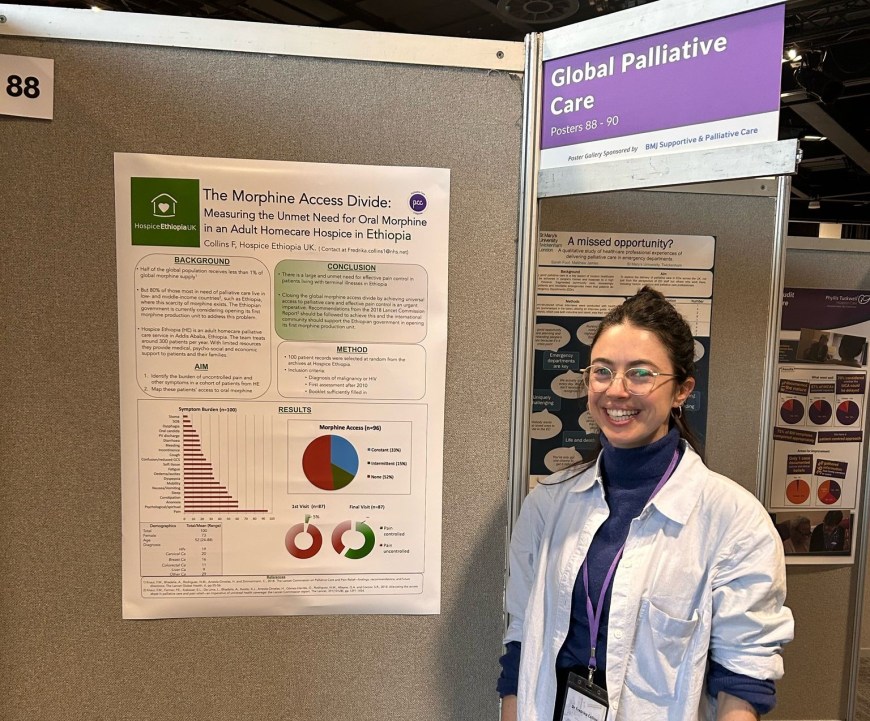
Hospice Ethiopia UK is delighted that our trustee, Freddie Collins, attended this year’s Palliative Care Congress in Belfast. This is the UK’s annual conference for palliative care practitioners and researchers. Here is her feedback:

“I was presenting an audit I completed while I lived in Ethiopia in 2024. For this audit, I went through the records of 100 patient notes to find out what symptoms they experienced and what medications the Hospice Ethiopia (HE) team used to manage their symptoms.

The main symptom that patients experienced was pain. 95% of cancer patients, and 91% of patients with HIV, experienced pain. On the first visit made by the HE team, only 5% of patients had their pain controlled. By their last visit, this proportion had increased to 60%. Most importantly, only 33% of patients had access to morphine, which is an essential medication to treat pain in patients at the end of their lives.

This audit shows two things. Firstly, how brilliant the HE nurses are! Even though they have a limited selection of tablet pain relief medications, they are still able to drastically improve pain in their patients. This is because, with your ongoing support, they are able to provide psychological, spiritual and economic support which helps to soothe pain in multi-dimensional ways.

Secondly, this audit highlights how an unmet need for pain control still does exist, as 40% of patients remain with uncontrolled pain at the end of their lives, but two thirds do not have access to oral morphine. If this study was repeated now on patients currently registered with Hospice Ethiopia, the access to oral morphine would probably be even more limited.

This inequitable access to morphine is a global problem. We can read in the 2018 Lancet Commission on Palliative Care and Pain Relief, how half of the global population receives less than 1% of global morphine supply. This audit therefore supports the urgent need for a reliable supply of oral morphine in Ethiopia and we hope that the Ethiopian government’s plan to develop a national morphine production unit will advance soon.”

An evening with General the Lord Dannatt GCB CBE MC DL

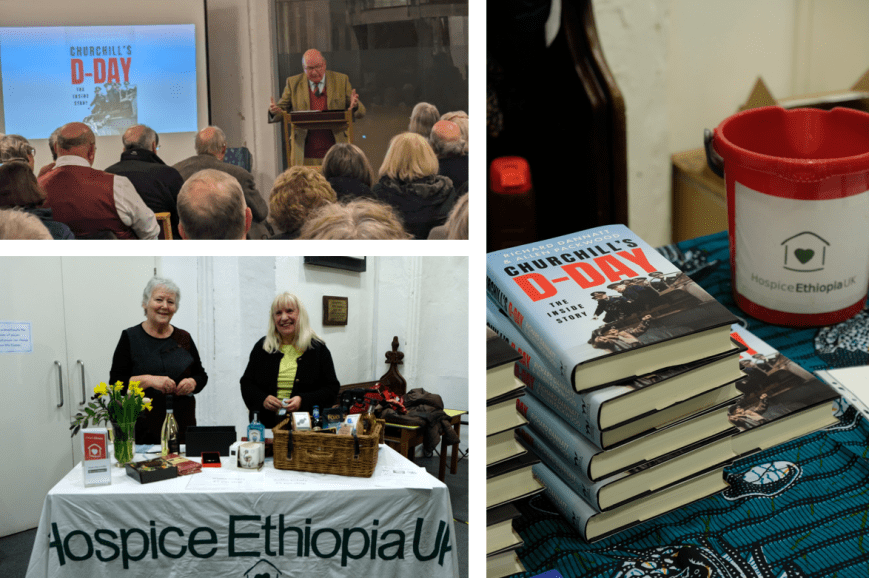
Hospice Ethiopia UK is enormously grateful to Richard Dannatt for giving a fascinating talk about Churchill and his role in the D-Day landings of Normandy. Through documents and letters from the Churchill Archives Centre in Cambridge, Richard gave the audience a vivid sense of the huge risks involved in the planning and execution of Operation Overlord, the largest land, sea and air operation ever staged. It proved to be a major turning point in the Second World War.

Thank you also to the enormously supportive audience, who enabled us to raise £1,730 through ticket sales and a raffle to support the work of Hospice Ethiopia.

Sue delighted to receive MBE

Chair of Hospice Ethiopia UK Sue Mumford has been made an MBE in the New Years Honours list in recognition of her services to palliative care in Ethiopia.

Sue has been involved in the charity since 2012, when a group of health care professionals at Priscilla Bacon Lodge started to support Hospice Ethiopia. She became chair of the group in 2016. Since 2012 Sue has visited Ethiopia thirteen times, most recently in November 2024 when she and her husband, retired doctor Jamie Mumford, helped run a training course in palliative care in the country.

Hospice Ethiopia was originally founded in 2003 by an Ethiopian nurse, Sister Tsigereda, who was saddened at the number of people who were left to die without adequate care in Addis Ababa, Ethiopia’s capital. Before that, there was no palliative care in the country, which now has a population in excess of 120 million. Over the years, with help from HEUK, the hospice has looked after thousands of patients, bringing relief to their suffering. Just as importantly, the hospice is a centre of excellence in Ethiopia and beyond, training hundreds of medics who in turn bring relief to thousands of desperate people and their families in Ethiopia and beyond. Support from the UK has been essential in this work, with HEUK raising around £60,000 a year. Trustees claim no expenses for their travel to Ethiopia so that all donations go where they’re really needed.

Sue works work closely with Hospice Ethiopia’s director, Ephrem Abathun, and has monthly calls with him so that HEUK can understand their needs and challenges and share in their successes.

Jill Morgan, one of HEUK’s trustees, says “The word ‘tirelessly’ is sometimes overused, but in Sue’s case it’s an understatement. I don’t think there is ever a time when she’s not either doing something for the charity or figuring out ways to progress its vital work. As well a leading the volunteers in the UK, she is always working at the heart of every fundraising event – everything from giving a talk to washing dishes, she’s there doing it. She thoroughly deserves this honour.”

Sue says “I am deeply honoured to receive this recognition, but this MBE is not just for me – it represents the incredible dedication of everyone at Hospice Ethiopia UK and our partners in Ethiopia. Together, we are ensuring that people with life-limiting illnesses can face their final days with dignity, comfort, and compassion. I hope this honour shines a light on the importance of palliative care and inspires further support for this vital work. I couldn’t have done any of this without fantastic support from my husband, family, trustees, and volunteers.”

Successful Jane Austen event raises £1560

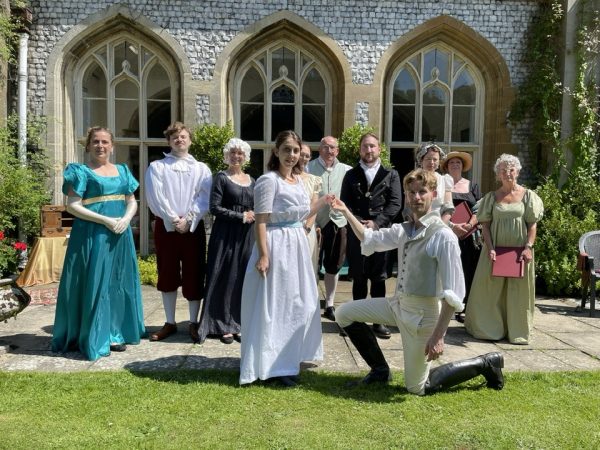
We had a fantastic event on Sunday 28th July with the dramatized reading from Jane Austen’s Northanger Abbey at Cromer Hall. The actors/readers were brilliant, the musicians fabulous and the high tea scrumptious. As for the setting – it was simply glorious, and we were lucky to have such wonderful weather. Huge thanks to Benjie and Dido Cabbell Manners for letting us use their beautiful home (and for providing a superb lunch for the workers). Massive kudos to script writer Margy Seale and the fabulous cast. Soprano Emma Nuule and her accompanist John Farmer were a delight, as was Jamie Mumford playing incidental music on his recorder. And then, as ever, there were all the background folk who contributed so much hard work – including the bakers, Kate, Rosie, Elizabeth and Julie and Sue, and the very hardworking tea folk, Claire, Julie, Rebecca, Steph and Rachael. And, of course, many thanks to the wonderful people who came and supported the event – raising £1560 in the process, which will make a huge contribution to support Hospice Ethiopia. The money raised is enough to pay for a specialist nurse looking after 100 patients for three months in Ethiopia.

The 2024 Jane Austen event sold out, as did the 2023 one… if you’d like to know about the 2025 event in time to grab a ticket or two, sign up to the newsletter at the bottom of this page.

June 2024 news from Ethiopia

Hospice Ethiopia UK’s Chair Sue Mumford has monthly online calls with Director of Hospice Ethiopia UK, Ephrem Abathun. Here is some of the latest news from Ethiopia:

  • Ephrem has been in discussions with the Ethiopian Ministry of Health about revising and publishing a new strategic plan for Palliative Care in Ethiopia. Crucially the provision of morphine is included for the first time in the revised plan.
  • The Minister of Health has now issued the necessary documents for the Black Lion Hospital to import morphine powder to produce oral morphine liquid. The American Cancer Society has purchased the morphine powder so we are optimistic that oral morphine solution will soon be available to relieve the pain for the dying in Ethiopia. Initially this medicine will be available for patients at Black Lion Hospital before being expanded to other hospitals in Addis Adaba and then to regional hospitals across the country.
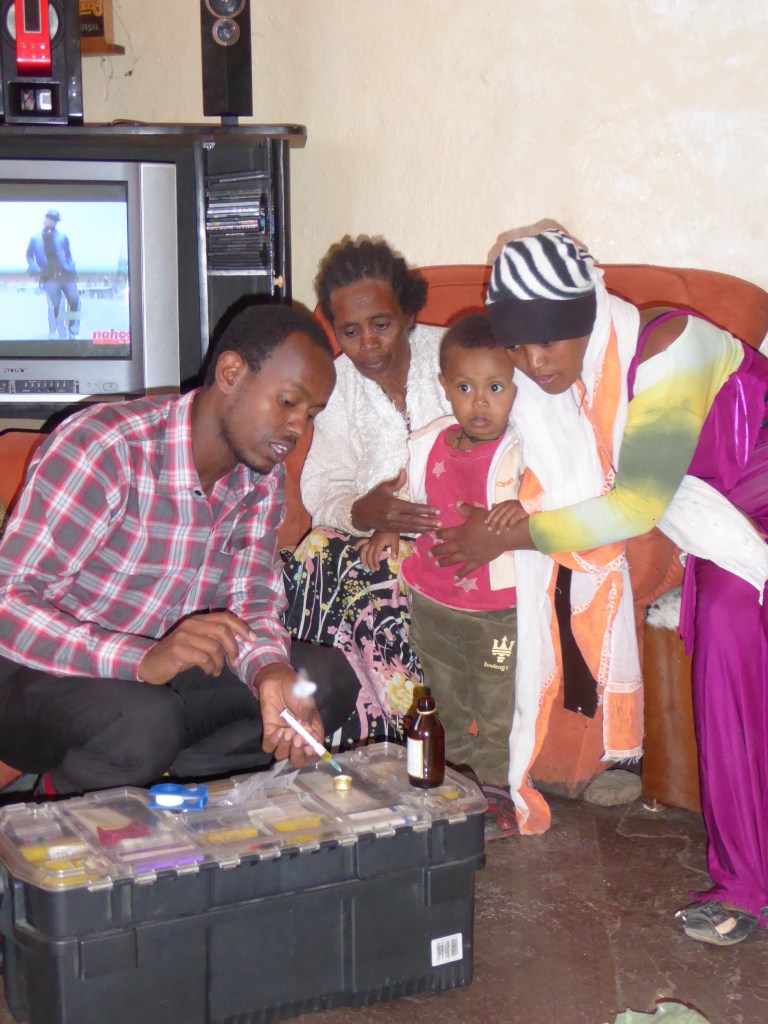
Ephrem teaching a family to administer oral morphine solution to a patient. Photo taken in 2016, when oral morphine was still available in Ethiopia.
  • Training: Ephrem and his staff laid on a workshop for Chaplains and representatives from the Christian Orthodox, Protestant and Muslim communities. Following this a draft training manual is being produced for training religious leaders in supporting terminally ill patients. As part of this work some of Hospice Ethiopia’s patients were questioned about what spiritual care they felt is needed when approaching the end of life. All this will help deliver the individualised care that people approaching the end of life deserve.
  • Following a joint application between Hospice Ethiopia and Hospice Ethiopia UK, True Colours Trust (a UK charity that supports palliative care providers across Africa) is providing funding for a 4 day palliative care training course at Hiwot Fana Hospital in Harar later this month. Harar is a holy Islamic city in eastern Ethiopia and is known for its maze-like alleys and traditional houses decorated inside with flat baskets.
  • Hospice Ethiopia UK and Hospice Ethiopia has recently been approached by Dr Yates from Soddo Christian Hospital (situated in the Oromia part of Southern Ethiopia) to provide palliative care training for their staff. The hospital serves a population of over 20 million people. Planning is in the early stages for this training to be delivered in the autumn when some of HEUK’s trustees will be visiting Ethiopia.

Doctor receives palliative care training funded by HE UK

Money raised by Hospice Ethiopia UK has been used to fund training for a doctor based in Southern Ethiopia, Dr Juhliad. His interest in palliative care started in 2019 when he received a three day introduction to palliative care at The Black Lion Hospital in Addis Ababa, delivered by Hospice Ethiopia’s Director, Ephrem. Dr Juhliad now works at Yabelo Hospital which is a town in the Oromia region, 580km south of Addis Ababa. Here he sees patients who desperately need symptom management and end-of-life care. With our help this year he has completed the foundation course in palliative medicine at Trivandrum Institute of Palliative Sciences and is now attending a Master Class course that will go on until December 2024. He will go to India for ‘hands-on’ clinical training in November 2024 as part of the course. This is what he told us:

“The hospital where I am based now doesn’t have a specific place dedicated to patients needing palliative care. And it seems difficult to persuade the hospital administrators to integrate palliative care services for now. But I am trying to integrate palliative care practice into my daily routine for patients who might be candidates for such services at a chronic disease medical outpatient department. Moreover, I am intending to launch a free telehealth service for patients needing palliative care through my social media platforms…I am also interested in providing webinars on palliative care for frontline healthcare workers.”